
Gregory Peck’s Secret Range: Comparing 3 Iconic Movie Quotes
Gregory Peck’s Three Iconic Quotes: The Paradox of the Baritone
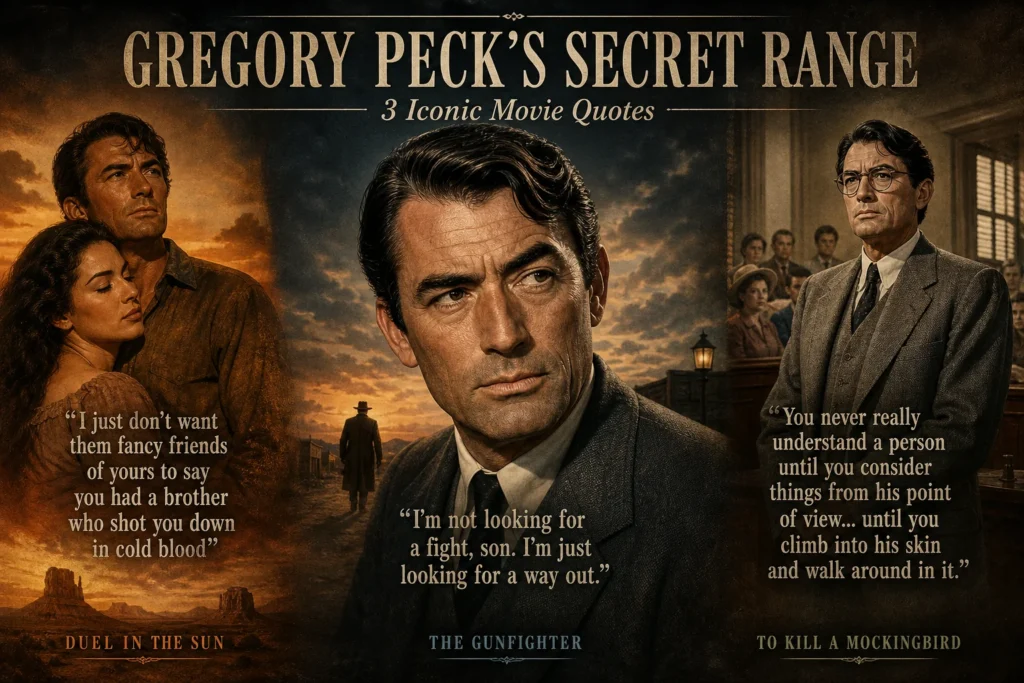
Gregory Peck’s iconic quotes are actually a dive into oceans of shades portrayed by the Gregory Peck. When we think of Gregory Peck, we usually conjure an image of moral steel. We see the upright posture of Atticus Finch or the stoic grace of a Roman reporter. But Peck’s greatness didn’t just lie in his goodness; it lay in his range. To understand the man, you have to listen to the dialogue—the way his voice could shift from a gentle whisper of wisdom to the jagged edge of a threat.
In this first entry of our “The Greats” series, we are dissecting three quotes that define the light and shadow of a Hollywood titan.
The Rogue: Duel in the Sun (1946)
“I just don’t want them fancy friends of yours to say you had a brother who shot you down in cold blood.“
Long before he became America’s father figure, Peck played Lewt McCanles—a reckless, ego-driven outlaw. This line is a masterclass in psychological warfare. He isn’t just threatening his brother; he is mocking his brother’s social standing and the “fancy” life he has chosen.
The Insight: Out of Gregory Peck’s iconic quotes, here in this film, Peck uses his deep voice as a weapon. There is no warmth here, only a sharp, biting arrogance. This is the “Shadow” of his career. It reminds the reader that Peck could play “dangerous” better than almost anyone, precisely because he looked so naturally respectable. He subverts his own dignity to create a villain that is both charming and terrifying.
The Anchor: To Kill a Mockingbird (1962)
“You never really understand a person until you consider things from his point of view… until you climb into his skin and walk around in it.“
If Duel in the Sun was the storm, this is the calm. This is perhaps the most famous piece of dialogue in cinematic history. Here, the baritone isn’t a weapon; it’s a blanket. It’s steady, rhythmic, and undeniably authoritative. It represents the moral peak of 20th-century cinema.
The Insight: Notice the difference in the intent. In Duel, he speaks to tear someone down. Here, he speaks to build someone up—specifically his daughter, Scout. Peck’s power as an actor came from his restraint. He didn’t need to shout to be the most powerful person in the room; he simply had to speak the truth with a voice that didn’t waver.
The Fatalist: The Gunfighter (1950)
“I’m not looking for a fight, son. I’m just looking for a way out.“
Between the outlaw and the hero lies Jimmy Ringo. In The Gunfighter, Peck plays a man trapped by his own reputation. This quote is weary. It’s the sound of a man who has seen too many sunsets and too many graves. It isn’t a threat or a lesson; it is a confession.
The Insight: This is the “Human” quote. It’s a bridge between the two extremes of his filmography. He has the gun skills of Lewt McCanles but the conscience of Atticus Finch. It’s the dialogue of a man who is tired of the myth and just wants to be a person.
Why This Comparison Matters
By placing these three lines side-by-side, we see the true trajectory of a legendary career. We see that Sir. Gregory Peck wasn’t just “the good guy”—he was a performer who deeply understood the cost of violence, the weight of morality, and the bitterness of regret.
What’s Next in “The Greats”?
This format—comparing the iconic with the unexpected—will be our roadmap for this series. Next week, we’ll look at a very different kind of titan: Arnold Schwarzenegger. We’ll ask if there is a deeper philosophy hidden behind “I’ll be back,” and compare his cold, robotic precision in The Terminator with the surprisingly dry wit of his later roles.
The curtain never falls on true legends. If you loved exploring the iconic legacy of Gregory Peck, journey next into the golden vault of cinema with our special features on Al Pacino and Arnold Schawz.