
No Other Choice Park Chan Wook AI Analysis
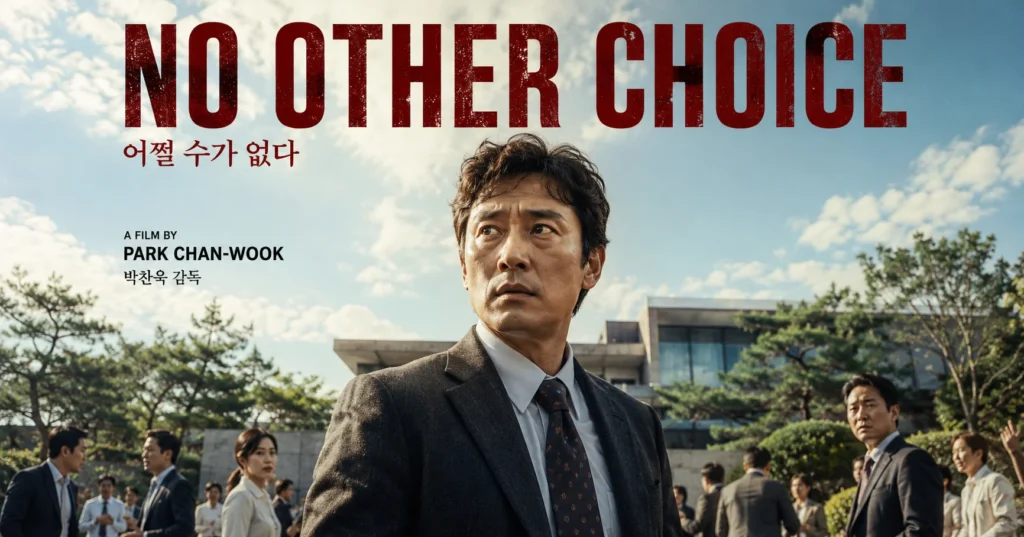
No Other Choice Park Chan-wook AI analysis explores (Deeply rooted in the ‘architecture of erasure’) how the master director’s latest vision reflects a global crisis of human obsolescence. From the tech hubs of the USA and Europe to the streets of Seoul and Australia, the film serves as a chilling mirror to a world where our very identities are being rewritten by silicon.
When Work Disappears Overnight
Weeks ago around thirty thousand employees of a major American tech giant woke up at dawn to an email that quietly ended their working lives. There was no accusation of failure, no complaint of negligence—only a polite line thanking them for their dedication, followed by the announcement that their services were no longer required. Imagine the silence that must have followed in thirty thousand homes, where routines collapsed with a single click. What makes it more unsettling is this: many of those workers had spent years training the very systems that would eventually replace them. Their diligence became the architecture of their own erasure.
This is not an isolated moment. It is a pattern—one that has echoed across industries, from chip manufacturers to online marketplaces to software empires. The rise of artificial intelligence is not just a technological shift; it is a quiet storm rearranging the meaning of work itself. What we are witnessing is not merely job loss, but the beginning of a deeper, more existential displacement: when a person is no longer needed for what once defined them, what remains of their identity?
A Story of Loss, Dignity, and Quiet Desperation
It is this question that lies at the heart of the story brought to life by the Korean master filmmaker Park Chan-wook, inspired by Donald Westlake’s novel. At its center is Man Soo, a paper factory manager whose life unravels when technological progress renders him obsolete. He is not introduced as a victim, but as a complete human being—a loving husband, a devoted father, and above all, a man deeply in love with his work. When that work is taken away, it is not just employment he loses; it is a part of himself that quietly disappears.
What makes Man Soo profoundly compelling is not rage, but restraint. He does not turn against the system that discards him. Instead, he searches, applies, waits—only to find himself competing with countless others just like him, equally skilled, equally desperate. In this quiet battlefield of survival, the enemy is no longer a corporation, but one’s own reflection in others. The tragedy deepens when a passing remark—half a joke, half a possibility—plants a dangerous idea in his mind. From that moment, the story begins to drift into darker territory, not with spectacle, but with an unsettling intimacy that forces us to ask how far an ordinary person might go when pushed to the edge.
The Poetry of Craft, Memory, and Human Fragility
Park Chan-wook does not tell this story in straight lines. He dissolves the boundaries between humor and horror, tenderness and violence, creating a world where emotions never arrive in pure form. His cinema understands a simple but often ignored truth: joy and sorrow are not opposites, but companions. A man can laugh at a funeral, and feel an ache in the middle of laughter. It is within this emotional ambiguity that the film finds its most honest voice.
One of the most unforgettable moments unfolds in a shoe store, where Man Soo encounters another former paper industry worker now reduced to selling footwear. Their conversation begins casually, but soon reveals a shared grief that words can barely contain. They do not speak of unemployment as statistics or inconvenience; they speak of it as a lost intimacy. When Man Soo describes the feeling of touching fine paper as something deeply comforting—almost tender—it transforms the ordinary into something sacred. It is no longer about paper; it is about belonging, about the quiet relationship between a person and the work that once gave meaning to their existence.
Performance That Feels Like Memory Itself
Lee Byung-hun’s portrayal of Man Soo is nothing short of extraordinary. He does not perform the character so much as inhabit him. In one moment, he is a composed professional in a job interview; in another, a vulnerable father shielding his child; and then, almost imperceptibly, a man slipping into moral uncertainty. What makes his performance remarkable is its refusal to dramatize suffering. Instead, he allows it to unfold in small gestures, pauses, and glances—those fleeting human details that feel more real than any grand display of emotion.
There is a quiet authenticity in the way he stumbles through his choices, never fully in control, never entirely lost. He is not a hero, nor a villain, but something far more unsettling: an ordinary man navigating extraordinary pressure. And in that ordinariness lies the film’s greatest strength, because it invites the audience to see not just him, but themselves.
A Reflection of Our Present, Not Just a Story
In this No Other Choice Park Chan-wook AI analysis we find that what makes this narrative resonate so deeply today is its uncanny relevance. The world it portrays is no longer distant or speculative; it is already here. The anxiety of being replaced, the erosion of identity, the fragile line between dignity and desperation—these are not cinematic inventions, but lived realities for millions. The film does not offer easy answers, nor does it attempt to justify its character’s descent. Instead, it holds up a mirror, asking us to confront the uncomfortable truth that under certain circumstances, anyone might stand where Man Soo stands.
In the end, this is not just a story about technology or unemployment. It is about what it means to be human in a world that is rapidly forgetting the value of human presence. It reminds us that work is never just work; it is memory, pride, rhythm, and belonging. And when it disappears, it leaves behind not silence, but a question—one that lingers long after the screen fades to black.