
Amitabh Bachchan and Kishore Kumar: The Duo That Stole the Limelight in Iconic Songs
Few actor-singer combinations in Bollywood history have created the kind of cinematic magic achieved by Amitabh Bachchan and Kishore Kumar. While Kishore Kumar’s powerful vocals gave life to Amitabh Bachchan’s on-screen persona in countless songs, there were rare moments when the duo did far more than entertain—they completely transformed the emotional direction of an entire sequence. Two films directed by Prakash Mehra stand as remarkable examples of this unique phenomenon.
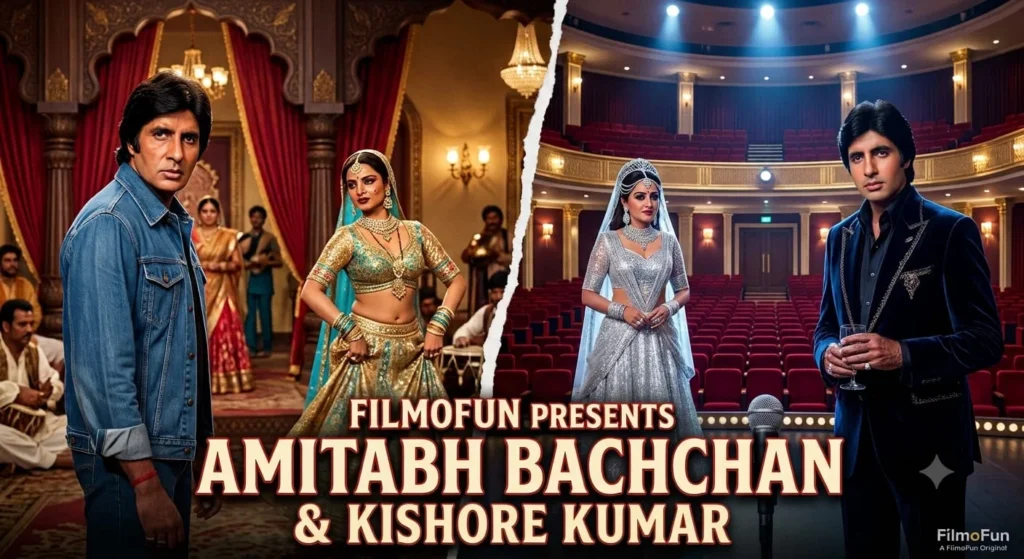
This is the story of the 1978 all-time blockbuster ‘Muqaddar Ka Sikandar’. It is the iconic scene where Sikandar, played by Amitabh Bachchan, arrives at the brothel of Zohra Bai (Rekha) for the very first time at his friend’s insistence. Guests sit leaning against bolster pillows on the shimmering floor, as Lata Mangeshkar’s magical voice echoes to the melodious tune of Kalyanji-Anandji. Moving gracefully to the lyrics penned by Prakash Mehra, Zohra Bai begins a traditional courtesan dance:
Salaam-e-ishq meri jaan zara qabool kar lo
Tum hum se pyaar karne ki zara si bhool kar lo
Mera dil bechain hai humsafar ke liye…
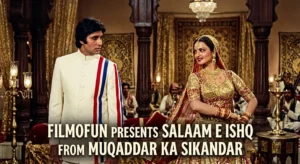
The song progresses in a traditional manner, but just as it reaches its halfway point, the narrative takes a dramatic 180-degree turn. A powerful vocal alaap from Kishore Kumar erupts from Sikandar’s throat, completely altering the atmosphere. In front of Zohra Bai—who is adorned in expensive, glittering attire, jewels, and flowers—stands Sikandar like a mountain in a simple shirt and jacket, completely stealing the emotional core of the song:
Iske aage ki ab daastan mujhse sun
Sunke teri nazar dabdaba jaay gi
Baat dil ki jo ab tak tere dil mein thi
Mera daawa hai honton pe aa jayegi
Tu maseeha mohabbat ke maaron ka hai
Hum tera naam sun ke chale aaye hain
Ab dawa de humein ya tu dede zehar
Teri mehfil mein yeh diljale aaye hai
Ek ehsaan kar apne mehmaan par
Apne mehmaan par ek ehsaan kar
De duayein tujhe umr bhar ke liye
Salaam-e-ishq meri jaan zara kubool kar lo
Here, the explosion of Kishore Kumar’s voice is so intense that Lata’s sweet melody temporarily fades into the background. In front of the pain hidden in Sikandar’s eyes and the smile playing on his lips, Zohra Bai’s traditional charm and dance pale in comparison. At this classic turning point, the combination of Amitabh Bachchan and Kishore Kumar completely dominates the entire sequence.
The Prakash Mehra Formula: Replicating the Magic of Amitabh Bachchan and Kishore Kumar
Remarkably, Prakash Mehra revisited this storytelling formula years later—not as a repetition, but as a fresh cinematic variation built around different characters and emotions.
Exactly six years later, director Prakash Mehra replicated this identical screen formula in a fresh and unique way in the 1984 super-hit film ‘Sharaabi’. This time, Amitabh Bachchan, playing Vicky Kapoor, arrives at a charity show with his assistant, where he encounters the stage performance of Meena (Jaya Prada) for the first time. Having bought all the tickets for the charity show beforehand, Vicky sits as the lone spectator in the massive, empty hall. To a beautiful composition by Bappi Lahiri and the vocals of Asha Bhosle, the semi-traditional lyrics written by lyricist Anjaan fill the air:
Mujhe naulakha manga de re o saiyaan deewane
Maathe pe jhoomar, kaano mein jhumka
Paon mein paaliya, haathon mein ho kangna
Tujhe mein, tujhe mein, tujhe seene se laga loongi o saiyaan deewane
How Amitabh Bachchan and Kishore Kumar Transformed a Cinematic Melodrama
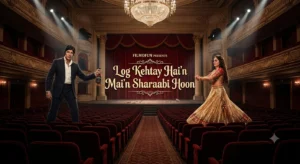
Seeing Vicky continuously drinking alcohol, Meena takes a sharp taunt at him through her lyrics: “Tere kadmon mein chhalka doongi mein saare maikhane” (I will spill all the taverns at your feet). This sarcasm pierces the alcoholic’s heart like an arrow. With a sorrowful, trembling alaap by Kishore Kumar, the staggering alcoholic rises from his chair and moves toward the stage. From this moment on, Vicky Kapoor rules the screen:
Log kehte hain main sharaabi hoon
tum ne bhi shayad yehi soch liya
haan log kehte hain main sharaabi hoon
kisi pe husn ka ghuroor, jawaani ka nasha
kisi ke dil pe muhabbat ki ravaani ka nasha
kisiko dekh ke saanson se ubharta hai nasha
bina piye bhi kahin had se guzarta hai nasha
nashe mein kaun nahi hai mujhe bataao zara
kise hai hosh mere saamne laao to zara
log kehte hain main sharaabi hoon
haan log kehte hain main sharabi hoon
Nasha hai sab pe magar rang nashe ka hai juda
khili,khili hui subah pe hai shabnam ka nasha
hawa pe khushbu ka, baadal pe hai rimjhim ka nasha
kahin suroor hai khushiyon ka, kahin ghum ka nasha
Nasha sharaab mein hota to naachti botal
maikade jhoomte, maikhaano mein hoti hulchul
nashe mein kaun nahi hai mujhe bataao zara
kise hai hosh mere saamne laao to zara
log kehte hain main sharaabi hoon
haan log kehte hain main sharaabi hoon
Through the second half of this legendary eleven-minute song, the melancholy of Kishore Kumar’s vocals grips the ears, while Vicky Kapoor’s face dominates the eyes. What began with a light smile and sharp sarcasm transforms by the end into a mesmerizing tragedy—marked by tears flowing from the eyes and blood dripping from hands cut by broken glass.
Once again, the vocal magic and unmatched screen presence of Amitabh Bachchan and Kishore Kumar completely overshadow Asha Bhosle’s singing and Jaya Prada’s beautiful dance, effortlessly walking away with the entire show.
Conclusion
These two unforgettable sequences demonstrate that Amitabh Bachchan and Kishore Kumar were far more than an actor and his playback singer. Together, they possessed the rare ability to alter the emotional heartbeat of a song, shifting the audience’s attention entirely through voice, performance, and screen presence. Whether in Muqaddar Ka Sikandar or Sharaabi, Prakash Mehra brilliantly used this formula to create two of Bollywood’s most memorable musical moments—moments where the duo didn’t merely participate in the song; they completely stole the limelight.
🎬 What to Read Next on FilmoFun
If you loved exploring how legendary creators redefine the emotional heartbeat of cinema, don’t miss our deep dive into the absolute masters of words and visual storytelling:
👉 True Honor of Cinema: A Comparative Analysis of Quentin Tarantino and Gulzar