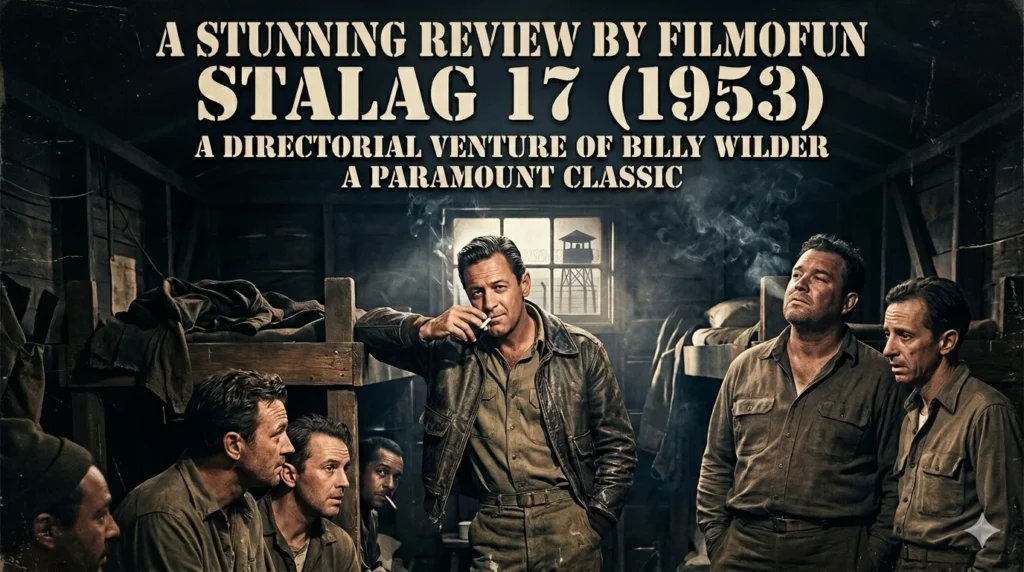

Stalag 17 (1953) Review
The Danube. Second only to Russia’s Volga, it is a river of mythic proportions. Emerging from the shadows of Germany’s Black Forest, it snakes across Central and Southeastern Europe before surrendering its identity to the Black Sea. It is perhaps the most well-traveled river on Earth, cutting through and breathing life into the landscapes of Austria, Slovakia, Hungary, Croatia, Serbia, Romania, Bulgaria, Moldova, and Ukraine. And it was somewhere along the banks of this very river that the camp was built, setting the stage for this classic Stalag 17 movie review. It is directed by the great Billy Wilder and has an IMDb rating of 7.9/10
“Stalag”—a German abbreviation for Stammlager—translates directly to “Main Camp.” Stalag 17 was a notorious central prison camp during World War II. While the sprawling complex held thousands of Allied prisoners segregated into various zones, our story zeroes in on a single compound, a specific barracks housing 640 American prisoners of war (POWs).
The Snitch in Barracks 4
The film hits the ground running. In Barracks 4, the prisoners orchestrate what they believe to be a foolproof escape plan for two of their comrades. But the illusion of safety shatters instantly. The plan fails, and the escaping prisoners are ruthlessly gunned down by German guards.
From that bloody threshold, a suffocating psychological warfare begins. A devastating realization grips the remaining men: there is a mole among them. Someone in their barracks is feeding intelligence to the German high command. Someone sold out their friends.
The man managing this specific human zoo is Feldwebel Schulz—a brilliantly written antagonist. Schulz plays the part of the ultimate “frenemy.” He smiles, crackles with jokes, and uses a veneer of affability to drop veiled, chilling threats. “I am your friend,” he tells them with a grin, “but if you make a mistake and they replace me, the next guy will be a monster.” Yet, behind this jovial facade lies a cold calculated truth: he has a spy embedded deep within the barracks.
Enter Sefton: The Ultimate Cynic
Then there is Sergeant Sefton, played by the legendary William Holden in an Oscar-winning performance. Sefton is sharp, fiercely opportunistic, and aggressively pragmatic. While others dream of heroism, Sefton runs a miniature capitalist empire inside the camp. He bets on anything and everything, accumulating mountains of cigarettes, which he expertly barters with the German guards for personal luxuries.
In a brilliantly contrasting scene, while the rest of the barracks chokes down a nearly inedible, foul camp breakfast, Sefton is casually frying a fresh egg for himself. It’s no surprise that the desperate, paranoid prisoners instantly tag him as the prime suspect. The film masterfully rides this wave of tension: Is Sefton the traitor, or is he just a scapegoat for a much deeper evil?
The Art of the Comic Relief
Traditionally, POW cinema is a grim affair, heavy with brutal torture and suffocating despair. But Billy Wilder flips the script. Stalagn 17 is remarkably light on its feet, infused with a vibrant, tragicomic wit. The characters are fiercely alive; they refuse to die a psychological death before actual death takes them. They have compromised with their reality, but not with their spirit.
Take the iconic duo of “Animal” and “Harry.” Animal (played by Robert Strauss) is a towering, lumbering goofball completely consumed by long-distance infatuation with a famous pin-up model. Harry (Harvey Lembik) acts as his dynamic anchor, constantly pulling Animal out of the ridiculous scrapes his dim-witted innocence gets him into.
This seamless blend of gravity and levity is the signature of director Billy Wilder. Collaborating with Edwin Blum on the screenplay, Wilder ensures that the two-hour runtime never suffers a single moment of boredom. It’s no wonder Wilder amassed 21 Oscar nominations and 5 wins across his legendary career as a director and screenwriter; he knew exactly how to make serious subjects wildly entertaining.
Stalag 17 Movie Review Captures the Bittersweet Heart of War
Wilder’s genius lies in scenes that make you laugh and ache simultaneously. When mail call finally arrives—the prisoners’ only lifeline to the outside world—Animal receives nothing. Harry, on the other hand, is bombarded with eight letters. The punchline? They are all aggressive notices from a collection agency tracking him down for debts back home.
Then there is the hopeless romantic who reads a letter from his wife to the entire barracks. She writes:
“You won’t believe how much I love you. You won’t believe it, but one day someone left a tiny baby girl on our doorstep, and I’m raising her. And you won’t believe that this little girl looks exactly like me.”
The prisoner looks up, entirely oblivious, and mutters, “God knows why my wife keeps saying ‘you won’t believe it’… of course I believe her!”
Set just a week before Christmas in 1944, the film peaks during a brilliant holiday sequence where the prisoners sing together, desperately clinging to a sense of home, while the German administration ironically hands out copies of Hitler’s Mein Kampf as Christmas gifts.
Final Thoughts: The Tragedy of Survival
In this Stalag 17 movie review we find that it is adapted from a Broadway stage play by Donald Bevan and Edmund Trzcinski;both of whom drew from their real-life traumas as actual POWs—Stalag 17 thrives on its rich ensemble cast. Every character carries distinct psychological baggage, but they all share the same terminal diagnosis: captivity.
And the root cause of that captivity is war.
Why are wars fought? Ostensibly to resolve conflicts. Yet, they resolve nothing; they only multiply misery and leave absolute devastation in their wake. No one truly escapes. Some die on the battlefield, while others are locked away in cages. For the dead, tears are shed. For the living, a wife writes from across the ocean, “You won’t believe it, but I am still yours.”
And the captive, staring at the barbed wire, replies, “Why shouldn’t I believe it?”