
Moral lessons in To Kill a Mockingbird
To Kill a Mockingbird: The Echo of Innocence in a Divided World
Moral lessons in To Kill a Mockingbird prove that some other novels are not just books, but more. The books that can haunt you and opens your mind and gives you a different view of life. This is the reason why the novel To Kill a Mockingbird should be considered such a novel. Written by Harper Lee, To Kill a Mockingbird is a book that rises above mere storytelling and becomes a moral philosophy of life.
Being set in the small and imaginary town of Maycomb, Alabama, somewhere around 1930s when Great Depression took its place in American history, this novel reveals to us the life seen through the eyes of a little six-year-old girl called Scout Finch who sees the life full of innocence and wonder around her. All is perfect in the outside world, but everything beneath is based on discrimination and inequality.

The central figures of the novel are the Finch family and include Scout herself, her brother Jem Finch and their father Atticus Finch who is morally clear-thinking lawyer. He is surrounded by his innocent children whose house is kept by Calpurnia, their strict and devoted Black caretaker.
Right next to Scout’s house stands the strange, scary house belonging to the mysterious person known as Arthur “Boo” Radley. For Scout and Jem, he becomes an enigma – one could say a ghost, legend and mystery personified.
The development of the story shows us a complete surprise – the person behind the curtain turns out to be a living person after all.
This is where Dill comes into play and brings an element of adventure to the world of those two little kids. This adventure becomes like an odyssey to find some meaning in reality.
But in this case, this reality is far from what can be called normal.
A moral conflict arises when Atticus Finch decides to defend Tom Robinson – an African American man accused of rape of a white woman. To do something like that was considered shameful and condemnable since those days, especially in such circumstances.
What happens in the trial is just the cruel truth of powerlessness against racial injustice. The jury, bound by the invisible yet unbreakable codes of racial hierarchy, delivers a judgment that echoes far beyond the courtroom.
This is when Jem and Scout realize that their perception of the world around them is shattered forever; they realize that justice can sometimes be unjust and that truth does not always triumph.
Atticus, however, is never afraid.
“…one thing that doesn’t abide by majority rule is a person’s conscience,” says Atticus to his children in one of the best quotes in the whole story.
This dedication, to maintaining a strong sense of morality even when facing an unavoidable defeat, elevates this man to the rank of a symbol; symbols of bravery, of a decent human being and of a person who refuses to bow down before injustice.
At the same time, there is another story, much more personal, which takes place along the central plotline. Slowly but surely, the children realize that Boo Radley, the man they were scared of so much, is actually the guardian angel who saves them from harm. He turns from an imaginary evil being into the symbol of misunderstood innocence.
It is in this chapter that one can see how the main metaphor works.
The Mockingbird
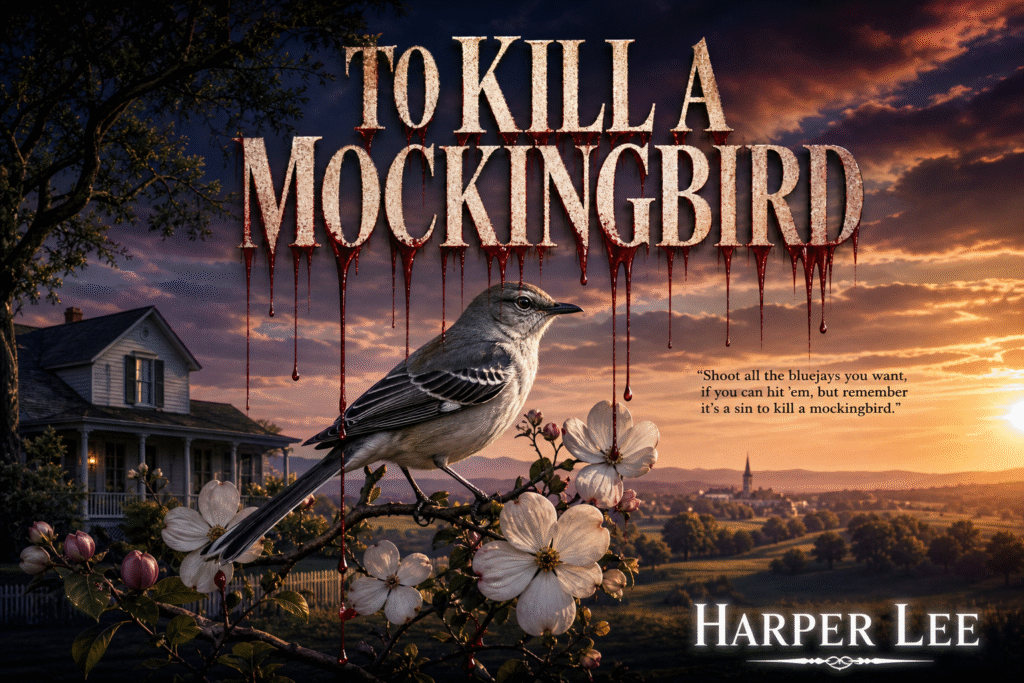
One of the most profound lessons in this story is that it is a sin To Kill a Mockingbird because all it does is make beautiful music for everyone else around it without hurting anyone. It is just there for everyone to enjoy.
Tom Robinson is a mockingbird.
Boo Radley is a mockingbird.
And maybe innocence as well is a mockingbird in many respects.
A Legacy beyond Time
The book To Kill a Mockingbird received tremendous acclaim soon after its publication, winning Harper Lee the Pulitzer Prize in 1961. It gained popularity that transcended literary genres by way of becoming a famous movie production and prompting numerous talks about racism, justice, and morals.
The appeal of the work has not been restricted only to countries where people speak English. This famous book has been translated into more than forty languages, including such Urdu versions as “Naghmay Ka Qatl (Murder of a Song)” by Altaf Fatima and “Masoomiyat Ka Qatl (Murder of Innocence)” by Shaukat Nawaz Niazi. The German translation of Harper Lee’s novel To Kill a Mockingbird is titled “Wer die Nachtigall stört“.
In the years since the release of this book, it has reached sales of more than tens of millions of copies. This book has become a standard for school curricula in many educational institutions around the globe, as much as for moral lessons as for literary ones.
Why It Still Matters?
What makes “To Kill a Mockingbird” a timeless classic isn’t only its story, but also its moral appeal. It challenges us to ask the hard questions:
How can there be justice in a world governed by bias?
How can there be integrity in a world where integrity is unwanted?
And how can innocence be maintained in a world where innocence is destroyed so easily?
These are as pressing issues now as ever before.
Final Reflection through Moral lessons in To Kill a Mockingbird
Lee authored only two books, and yet through this one book, she has managed to earn her a seat amongst the greatest writers of the present age. She was honored with the Presidential Medal of Freedom in 2007, and when she died in 2016, she did not leave behind only books—she left behind her legacy.
To Kill a Mockingbird is more than just a story to be read.
It is an experience to be lived.
It tells us that despite the existence of evil in the world, it is always possible to shine light on the darkness through the power of conscience.
And above all, it tells us that the greatest tragedy is not the corruption of innocence, but its protection.