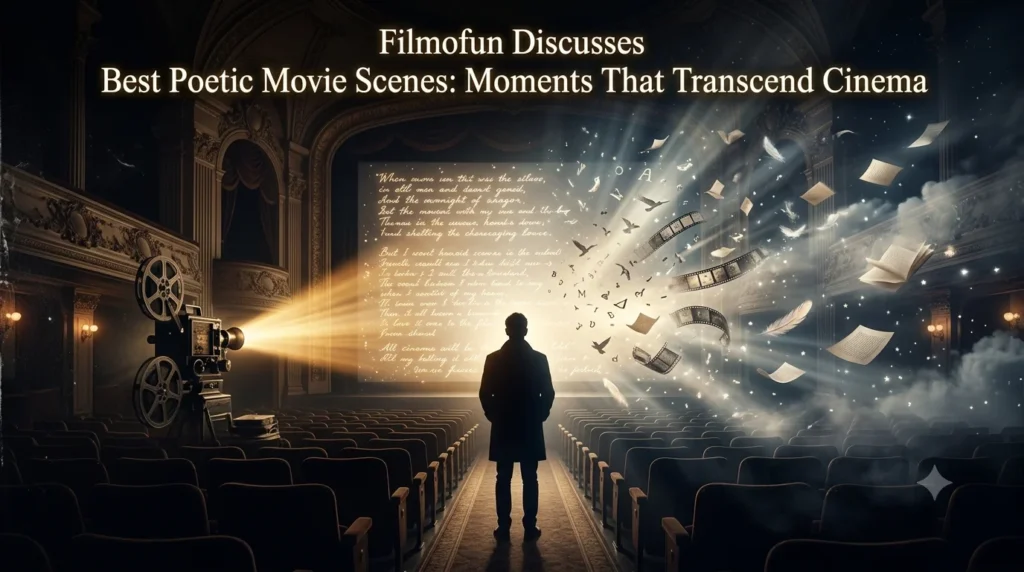

The Best Poetic Movie Scenes of All Time: Why Some Moments Feel Like Poetry Instead of Cinema
“Some films tell stories. Others leave behind memories that feel more like verses than scenes.”
Before reading about best poetic movie scenes, think Have you ever watched a movie scene that lingered in your mind long after you had forgotten most of the plot? Perhaps it was a slow dance in a crowded restaurant. A solitary figure standing in a doorway flooded with light. A silent glance exchanged between two people who never fully confessed what they felt. Nothing spectacular seemed to happen, yet something inside you quietly shifted.
These are the moments we return to again and again; not because they advance the story, but because they capture something words rarely can.
When film lovers search for the best poetic movie scenes of all time, they are usually looking for breathtaking cinematography or unforgettable performances. Yet what truly makes these scenes extraordinary goes much deeper than beautiful images. They don’t simply entertain us; they awaken memories, emotions, and longings we may never have known we carried.
Like a great poem, they refuse to explain themselves completely. Instead, they invite us to feel.
Cinema is often called the youngest of the arts, yet its greatest moments borrow from one of humanity’s oldest traditions: poetry. Both compress enormous emotional worlds into a handful of carefully chosen images. Both trust silence as much as language, understanding that the deepest truths are often suggested rather than spoken.
Perhaps that’s why these lyrical sequences remain unforgettable. Years after we’ve forgotten entire plots, a single silhouette, a dance, a tear, or a beam of sunlight continues to echo somewhere in our memory.
This article isn’t another standard list of beautiful scenes. Instead, it explores a more fascinating question: Why do some movie scenes feel like poetry instead of cinema? To answer that, we need to look beyond traditional storytelling and discover the hidden architecture of emotion.
Projector whispers—
silent hearts become verses
after the credits
Why These Masterpieces Stay With Us
Most movies ask us one question: “What happens next?” Poetic cinema asks a different one: “What does this moment feel like?” That single difference changes everything.
Traditional storytelling is built on movement. Every scene pushes the narrative toward its destination—characters make decisions, conflicts escalate, and mysteries are solved. Poetic filmmaking, however, is far less interested in speed. It pauses. It breathes. It allows us to inhabit a single emotional moment without rushing toward the next plot point.
Think about the last poem you truly loved. You probably don’t remember it because of its story. You remember it because of one image, one rhythm, one unexpected metaphor, or one silence between two lines.
The best poetic movie scenes of all time work exactly the same way. They transform cinema into an emotional language rather than a purely narrative one.
The Hidden Elements of Cinematic Poetry
Great poetic scenes aren’t accidents. They are carefully crafted through a combination of visual language, sound, rhythm, symbolism, and performance. Let’s look at the elements that give these scenes their extraordinary emotional power.
Visual Imagery That Speaks Without Words
In ordinary storytelling, an object usually serves a practical purpose. A window is simply a window, a road leads somewhere, and rain merely changes the weather. Poetic cinema transforms these ordinary objects into emotional symbols. A half-open door may become hope; a cracked mirror may represent a fractured identity; a lonely tree can suggest endurance, grief, or memory.
Directors rarely explain these meanings—they trust viewers to feel them. That’s what poetry has always done. Rather than delivering flat answers, it creates images that continue unfolding inside our imagination long after the experience has ended.
Music That Doesn’t Tell Us What to Feel
Many commercial films use music as emotional instruction: fast music means excitement, violins mean sadness, and heavy drums mean danger. Poetic cinema treats music differently. Instead of commanding our emotions, it quietly converses with the images.
Sometimes the music contradicts what we see—a joyful melody accompanies heartbreaking events, or absolute silence follows emotional chaos. In these moments, a single piano note becomes more devastating than an entire orchestra. Music stops being background noise and becomes an active character.
Silence: The Most Underrated Sound in Cinema
Modern audiences live inside constant noise—dialogue, notifications, traffic, and social media. Because our lives are so loud, silence has become one of cinema’s most powerful artistic tools. When a filmmaker removes dialogue and music, something remarkable happens: we begin hearing everything else.
A slow breath, footsteps, the rustle of fabric, a trembling hand, or the heavy space between two people. Silence forces us to participate emotionally rather than passively consuming information. Some of the most iconic movie scenes contain surprisingly few words; their silence becomes their language.
Rhythm: Why Editing Can Feel Like Verse
Poetry has rhythm. Not every poem rhymes, but every memorable poem possesses a pulse. Cinema has rhythm too, and editing determines how that time flows. Commercial films often cut rapidly to maintain high energy, but poetic films do the opposite.
They linger. A shot lasts ten seconds instead of three. The camera quietly observes instead of chasing action, and time itself begins to stretch. We stop watching events and begin experiencing them. That’s why some scenes feel dreamlike; they are no longer following the rhythm of a plot, but the rhythm of memory.
Performances Built on Restraint
Many unforgettable performances aren’t remembered because actors shouted; they are remembered because they almost didn’t speak. Poetic acting relies entirely on suggestion—a slight hesitation, a lowered gaze, a barely noticeable smile, or eyes filling with tears that never fall. The actor trusts us to complete the emotion ourselves. That trust creates immense intimacy. Instead of merely witnessing an emotion, we begin sharing it.
Case Studies in Cinematic Verse
Case Study I: The Tree of Life — When Childhood Becomes a Prayer
Few films illustrate the power of visual lyricism more beautifully than Terrence Malick’s The Tree of Life. The film doesn’t unfold like a conventional narrative; it drifts, remembers, and meditates. Its most powerful moments don’t explain childhood; they recreate the emotional texture of remembering childhood decades later.
Sunlight filtering through trees, children running barefoot across wet grass, a mother’s hand brushing gently against curtains moving with the wind—nothing here exists simply because it looks beautiful. Every image carries immense emotional weight. Light becomes innocence, nature becomes memory, and the universe itself becomes part of a family’s private grief.
Malick rarely tells us what characters are thinking. Instead, he lets movement, light, and whispered prayers communicate emotions beyond ordinary language. Watching these scenes feels less like following a screenplay and more like reading a collection of visual psalms. This is cinema approaching pure poetry.
Case Study II: Scent of a Woman — The Tango That Speaks About Life
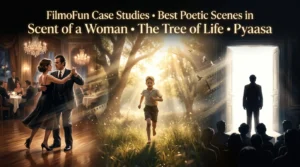
Some scenes become legendary because they’re brilliantly choreographed, while others endure because they quietly reveal something universal about being human. The famous tango sequence in Scent of a Woman accomplishes both. Frank Slade, a blind, retired Army officer played by Al Pacino, asks a stranger named Donna for a dance.
On paper, almost nothing happens. Nobody confesses love, no dramatic revelation changes the plot, and no action sequence interrupts the music. Yet millions of viewers remember this scene decades after first seeing it. Why? Because the dance becomes a profound metaphor for life itself.
Frank cannot see, Donna is nervous, and yet the music begins. For a few extraordinary minutes, trust replaces certainty, movement replaces explanation, and grace replaces fear. Frank’s famous words, “If you make a mistake… get all tangled up… you just tango on,” are not really about dancing; they are about living.
Pacino’s performance is astonishing precisely because it avoids excess. His eyes remain unfocused and his posture never begs for sympathy. Instead, every movement suggests a man refusing to surrender his dignity despite immense loss. The restaurant gradually disappears, the orchestra seems to breathe alongside the dancers, and time slows down. The sequence transforms an ordinary event into something timeless, reminding us that sometimes the most profound truths are danced rather than spoken.
Case Study III: The Mirror — When Memory Becomes Cinema
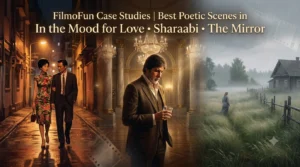
If there is one film that critics across the world consistently describe as pure visual poetry, it is Andrei Tarkovsky’s The Mirror (1975). Unlike conventional films, The Mirror refuses to tell a straightforward story. There is no clear beginning, middle, or end. Instead, it unfolds like memory itself: fragmented, nonlinear, and deeply personal.
Watching The Mirror can feel like wandering through someone’s dreams. A gust of wind moves through a field, a mother washes her hair, a barn catches fire in slow motion, and rain falls with hypnotic patience. On paper, these moments appear almost insignificant. On screen, they become unforgettable emotional revelations.
Tarkovsky once wrote that cinema should “sculpt in time.” That idea is visible throughout this masterpiece. Instead of compressing time, he stretches it, inviting us to dwell inside a single emotion. Every frame feels carefully composed, functioning as a deep meditation. Silence is never empty, wind is never just weather, and water is never simply water. Each element carries a profound spiritual meaning, resulting in cinema that behaves like poetry—open to interpretation, impossible to exhaust, and different every time we return to it.
Case Study IV: In the Mood for Love — The Poetry of Everything Left Unsaid
Few films understand longing as profoundly as Wong Kar-wai’s In the Mood for Love. Ironically, this acclaimed piece of poetic filmmaking contains almost no dramatic confessions. Two neighbors slowly discover that their respective spouses are having an affair. The expected Hollywood response would be high-pitched confrontation, but Wong Kar-wai chooses absolute restraint.
The characters continue passing each other in narrow hallways, sharing quiet meals, walking slowly through rain-soaked streets, and standing beneath streetlights glowing softly in the night. What remains unspoken becomes far more important than the dialogue itself.
Christopher Doyle’s cinematography turns every corridor into an emotional landscape filled with warm reds, deep shadows, and lingering slow motion. Every visual choice reflects their emotional imprisonment. Furthermore, the repeated use of Michael Galasso’s haunting violin theme creates a rhythm that feels almost hypnotic, with each repetition resembling the refrain of a beautiful poem. Nothing changes, yet everything changes. The audience begins to understand that longing is often more powerful than fulfillment, and that love sometimes exists most beautifully in its absence.
Case Study V: Pyaasa: Guru Dutt’s Masterpiece of Visual Poetry
When discussions of poetic cinema focus exclusively on European and American filmmakers, they overlook one of the greatest visual poets in film history: Guru Dutt. Released in 1957, Pyaasa remains one of the finest examples of lyrical filmmaking ever created, dealing with timeless themes of loneliness, artistic integrity, and spiritual hunger.
The film reaches its emotional summit during the unforgettable performance of “Yeh Duniya Agar Mil Bhi Jaye To Kya Hai.” The setting is simple yet grand: a crowded auditorium, a superficial society celebrating success, and a poet believed to be dead.
Then, Vijay appears. He stands alone in a doorway flooded with blinding white light. His body becomes a dark silhouette, and his outstretched arms subtly evoke the image of a crucifix. The composition is breathtaking. Without speaking a single explanatory sentence, Guru Dutt communicates everything.
The doorway becomes the threshold between truth and illusion; the light suggests both redemption and alienation; and the crowd represents a society that values fame more than humanity. Meanwhile, Sahir Ludhianvi’s devastating lyrics and S. D. Burman’s unforgettable composition transform the sequence into a cinematic elegy. Every camera movement follows the rhythm of the song. The scene isn’t merely photographed—it is orchestrated like a poem. Its emotional language is completely universal, proving that the pain of being misunderstood requires no translation.
Case Study VI: Sharaabi — The Loneliness Hidden Behind Luxury
Mainstream commercial cinema is not usually associated with poetic minimalism, yet every so often, a popular film contains moments that completely transcend its genre. Prakash Mehra’s Sharaabi is one such example. While many viewers remember the film for its catchy songs and larger-than-life humor, beneath its commercial surface lies a deeply melancholic character study.
Vicky Kapoor has everything money can buy—palaces, luxury cars, and immense influence—yet he remains emotionally abandoned. His greatest poverty is not financial; it is a total lack of affection.
Some of the film’s quietest scenes reveal this truth with incredible visual poetry. Vicky stands alone inside enormous, cavernous rooms that seem far too large for one human being. Glittering crystal chandeliers sparkle overhead and expensive furniture fills the frame, yet the overwhelming scale of the environment only serves to physically shrink him, emphasizing his isolation. The cold emptiness surrounding him becomes the real subject of the scene.
Amitabh Bachchan delivers one of the most remarkably restrained performances of his career here. His dialogue is slow, his pauses feel deliberate, and his intoxication seems less about alcohol than pure emotional exhaustion. His famous song “Log Kehte Hain Main Sharaabi Hoon“ is often celebrated for its melody, but beneath the wit lies a profound cry for love. The laughter becomes self-defense, the alcohol becomes a metaphor, and the performance becomes a confession. The empty glass in Vicky’s hand quietly symbolizes a life overflowing with wealth but completely emptied of meaning.
The Grammar of Storytelling vs. The Language of Poetry
Understanding what separates these cinematic milestones from standard films becomes easier when we look at how they approach the core elements of filmmaking:
| Element | Traditional Narrative Cinema | Poetic Cinema |
| Primary Goal | Moves the plot forward efficiently | Evokes deep emotion and reflection |
| Time | Fast, linear, and goal-oriented | Slow, meditative, and dreamlike |
| Dialogue | Explains events and drives action | Suggests underlying emotions and subtext |
| Images | Illustrate physical actions | Function as deeper emotional metaphors |
| Music | Supports and dictates the mood | Becomes an active storytelling language |
| Silence | Used as brief narrative pauses | Functions as a powerful emotional instrument |
| Editing | Maintains invisible continuity | Follows a rhythmic, lyrical, and contemplative pulse |
| Audience Experience | Asks: “What happens next?” | Asks: “What am I feeling right now?” |
Poetry Has No Nationality
We’ve seen some best poetic movie scenes; One of cinema’s greatest misconceptions is that poetic filmmaking belongs primarily to a specific region or arthouse culture. Certainly, masters like Tarkovsky, Malick, and Wong Kar-wai expanded the possibilities of the medium. But poetry has never respected borders.
Japanese cinema gave us Yasujirō Ozu’s delicate, stationary stillness. Iranian cinema transformed ordinary childhood into philosophical meditation. Indian filmmakers such as Guru Dutt and Bimal Roy infused mainstream storytelling with extraordinary lyricism. Even Hollywood occasionally pauses its relentless pursuit of spectacle to create moments of breathtaking emotional stillness.
Poetic cinema is not a restrictive genre; it is a way of seeing. It asks directors to trust the audience, it asks viewers to slow down, and it reminds us that images often reveal truths language cannot.
Why These Moments Never Leave Us
What makes us return to certain movie scenes decades after we’ve forgotten the plot? It’s rarely because we remember every line of dialogue. It’s because we remember how those scenes made us feel.
A doorway filled with light. Two lovers passing each other in a narrow alleyway in silence. A lonely millionaire staring into an empty glass in a glittering mansion. A blind man dancing as though he can still see the beauty of the world. A poet standing before a crowd that recognizes his genius too late.
These moments survive because they bypass logic and speak directly to human memory. Neuroscientists often describe memory as emotional rather than photographic. We rarely preserve life events exactly as they occurred; instead, we remember fragments—a face illuminated by afternoon sunlight, the sound of rain against a window, or a melody playing somewhere in the distance. The best poetic movie scenes of all time work in exactly the same way. They don’t simply tell stories; they become part of our own memories.
Technology changes, visual effects become outdated, and cameras improve, but genuine emotion remains entirely timeless. A black-and-white frame from Pyaasa can move a young viewer today just as powerfully as it did audiences seventy years ago. The slow-motion walks in In the Mood for Love still feel remarkably modern. The tango from Scent of a Woman continues to inspire across generations, and the whispered prayers of The Tree of Life still awaken something quietly spiritual.
Stories entertain us. Poetry transforms us. The greatest filmmakers understand how to do both, ensuring that these moments continue to echo long after the credits roll—not as scenes we merely watched, but as feelings we still carry with us.
Frequently Asked Questions
What makes a movie scene poetic?
A poetic movie scene focuses less on advancing the plot and more on expressing complex emotions through imagery, symbolism, rhythm, silence, and music. Like a poem, it invites individual interpretation rather than offering a single, simple explanation.
Which films contain the best poetic movie scenes of all time?
Cinema classics frequently cited by critics include The Tree of Life, The Mirror, In the Mood for Love, Scent of a Woman, Pyaasa, and Sharaabi for their emotionally resonant and visually lyrical sequences.
Is poetic cinema a separate genre?
No. Poetic cinema is an artistic approach rather than a specific genre. It can appear in dramas, romances, historical epics, independent art pieces, or mainstream commercial movies whenever a filmmaker prioritizes emotional depth over conventional plot progression.
Why do poetic movie scenes stay in our memory longer?
Because they appeal to emotional memory rather than factual information. Instead of asking viewers to track a sequence of events, they invite them to experience a feeling. Human minds naturally retain emotional impressions far longer than plot details.
Can commercial, mainstream films contain truly poetic scenes?
Absolutely. While visual poetry is often associated with niche arthouse directors, mainstream popular cinema is full of deeply lyrical moments. The legendary tango sequence in Scent of a Woman and the profound character studies within Sharaabi demonstrate that poetic beauty can flourish anywhere.
Final Thoughts
The next time someone asks you why a particular movie scene never left your mind, resist the temptation to summarize the plot. Instead, describe the feeling. Perhaps that’s the truest measure of cinematic greatness: when a film stops asking us to watch, and quietly teaches us how to feel.
When stories fall still,
the light begins speaking first—
cinema breathes verse