
From Homer to IMAX: The Eternal Voyage of the Odyssey
Few stories possess the gravity to anchor human culture for nearly three millennia, but Christopher Nolan’s The Odyssey is set to prove that the myth remains timeless. Homer’s original epic poem, composed in the 8th century BCE, is not merely one of the oldest surviving pieces of Western literature; it is the definitive blueprint for the classic adventure story.
As director Christopher Nolan gears up to unleash his monumental cinematic adaptation on July 17, 2026, the world is looking back at how this ancient myth shaped civilizations, tracing its previous adaptations, and uncovering why Nolan’s version is poised to make cinematic history.
Christopher Nolan’s The Odyssey: A Brief Idea of the Ultimate Journey
At its core, The Odyssey is a story about the agonizing, perilous struggle of homecoming. It follows Odysseus, the cunning King of Ithaca, as he attempts to return home after the fall of Troy. While the Trojan War lasted a grueling ten years, Odysseus’s journey back takes an additional ten.
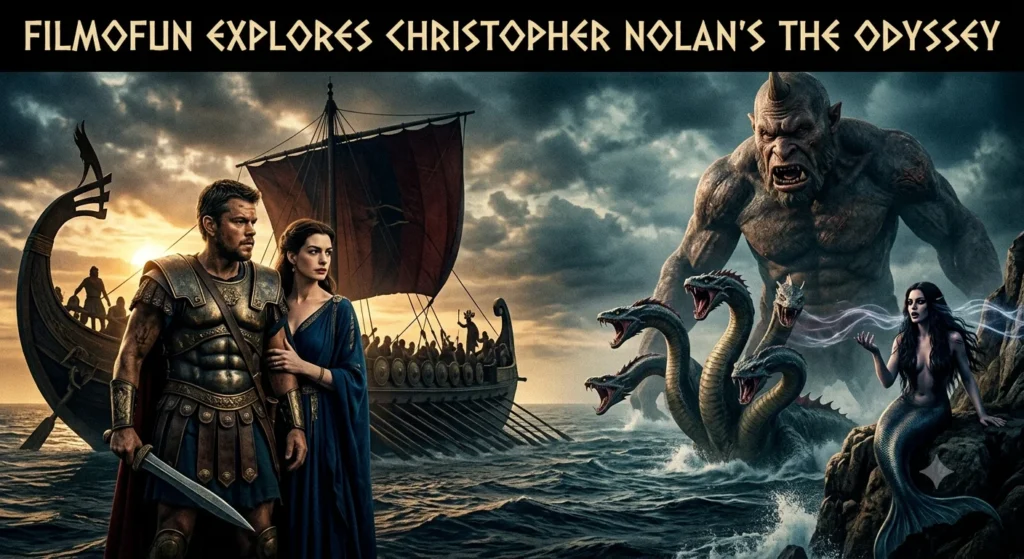
Accused of arrogance by the gods, Odysseus is cast out into the supernatural perils of the Mediterranean. His voyage becomes a gauntlet of nightmares:
- He outsmarts the man-eating Cyclops, Polyphemus.
- He resists the deadly, mesmerizing songs of the Sirens.
- He navigates between the crushing whirlpool Charybdis and the six-headed monster Scylla.
- He spends years imprisoned by the enchanting goddess Calypso.
Meanwhile, back in Ithaca, his loyal wife Penelope and young son Telemachus must fend off a vicious pack of aggressive suitors who have overrun their estate, assuming Odysseus is dead. The epic is a masterful exploration of nostos (the longing for home), xenia (the sacred law of hospitality), and the limits of human endurance.
Shaping the World: Impact on Civilizations
The impact of The Odyssey on global civilization cannot be overstated. For the ancient Greeks, it served as a cultural Bible. It taught moral codes, religious piety, and what it meant to possess metis—a specific brand of cunning, practical intelligence that the Greeks valued just as much as physical strength.
Over the centuries, the epic permanently altered the landscape of human storytelling:
Homer’s Odyssey ──> Virgil’s Aeneid ──> James Joyce’s Ulysses ──> The Modern “Road Trip” & Hero’s Journey
It laid the foundational bricks for Western literature, directly inspiring Virgil’s Roman epic The Aeneid and fundamentally shaping the “Hero’s Journey” narrative framework popularized by mythologist Joseph Campbell. In 1922, James Joyce used it to structure Ulysses, arguably the most important modernist novel ever written.
Even our modern vocabulary is entirely indebted to Homer. The very word “odyssey” has evolved into a universal noun representing any long, transformative journey. Every time we watch a space expedition, a high-stakes road trip, or a psychological survival movie, we are watching a spiritual descendant of Odysseus.
The Myth on Screen: Previous Cinematic Adaptations
Given its massive scale, capturing The Odyssey on film has always been a logistical nightmare, resulting in a surprisingly sparse history of direct adaptations.
| Era / Year | Title | Style / Format | Key Characteristics |
| 1954 | Ulysses | Hollywood Peplum Film | Starred Kirk Douglas. It scaled down the mythological elements to focus heavily on the domestic drama and a classic, rugged Hollywood hero. |
| 1968 | L’Odissea | Italian TV Miniseries | Directed by Franco Rossi. Praised for its fidelity to Homer’s text and its eerie, atmospheric depiction of the supernatural elements. |
| 1997 | The Odyssey | NBC TV Miniseries | Directed by Andrei Konchalovsky and starring Armand Assante. It utilized early CGI to bring the monsters to life, winning an Emmy for its impressive scale. |
| 2000 | O Brother, Where Art Thou? | Coen Brothers Satire | A brilliant, loose adaptation set in the American South during the Great Depression. George Clooney’s Ulysses Everett McGill mirrors Odysseus in a folk-music odyssey. |
Christopher Nolan’s The Odyssey: What Makes It Special?
Following his sweeping Oscar triumph with Oppenheimer, Christopher Nolan is leaping from the dawn of the atomic age backward three thousand years. Clocking in at a massive 172 minutes with a record-shattering $250 million budget, his upcoming film, The Odyssey, aims to redefine the historical action-fantasy genre.
Nolan’s take on Homer’s myth is unique because of its unprecedented scale and technical ambition.
-
A Technical Masterpiece: 100% Native IMAX
Historically, filmmakers have used large-format IMAX cameras exclusively for specific, high-octane set pieces due to the immense size, weight, and loud operational noise of the cameras. Nolan has smashed through this barrier. Working alongside cinematographer Hoyte van Hoytema and utilizing brand-new, lighter-weight large-format technology, The Odyssey is the first feature film in cinema history to be shot entirely on IMAX film cameras. Audiences will experience ancient Greece with an unprecedented, ultra-crisp visual depth that mirrors the overwhelming scale of the sea.
-
Radical Commitment to Practical Effects
Where modern blockbusters rely heavily on blue screens and computer-generated imagery, Nolan is taking a fiercely practical approach. The legendary Trojan Horse sequence was filmed across international locations—including Greece, Morocco, Italy, Iceland, and Scotland—featuring massive practical sets and thousands of real background actors. Rather than rendering monsters like the Cyclops or Scylla through generic digital assets, Nolan’s team is utilizing massive mechanical animatronics and optical illusions to give the mythological threats a visceral, terrifying tangibility.
-
A Star-Studded, Psychological Powerhouse
Nolan has assembled an elite ensemble cast to bring the psychological gravity of the poem to life:
- Matt Damon steps into the sandals of Odysseus, bringing the weary, brilliant grit required of a general trying to crawl back to his family.
- Anne Hathaway plays the enduring Penelope, while Tom Holland portrays their son, Telemachus.
- Shifting the gods from distant cosmic entities to grounded, overwhelming figures, Zendaya embodies the tactical goddess Athena, while Charlize Theron steps into the role of Calypso.
- The film further rounds out its powerhouse cast with stars like Robert Pattinson as the villainous suitor Antinous, and Lupita Nyong’o in a dual role as Helen and Clytemnestra.
Accompanied by a sweeping, experimental score by Ludwig Göransson, Christopher Nolan’s The Odyssey promises to strip away the campiness often associated with sword-and-sandal epics. By treating the text not as an antiquated fairytale, but as a visceral, high-stakes psychological survival thriller, Nolan is poised to prove Homer’s assertion: no matter how many millennia pass, the human longing for home remains the ultimate adventure.