
True Honor in Cinema: Tarantino vs. Gulzar on Ego
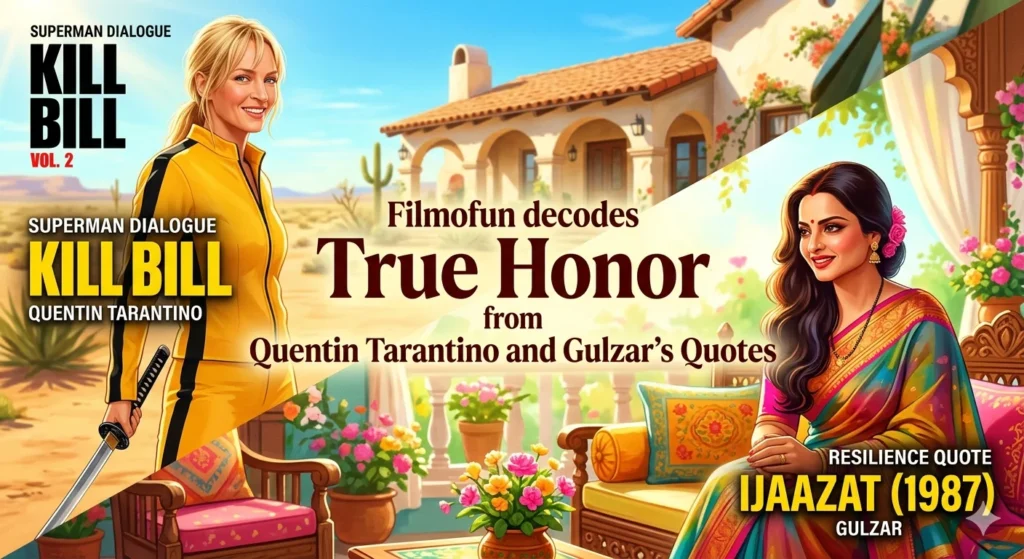
Cinema has always been our mirror, but depending on where you look, that mirror reflects different parts of our psychology. Today, filmofun compaires two master storytellers into conversation: the gritty, hyper-pop Western auteur Quentin Tarantino (Kill Bill), and the soul-stirring Eastern poet-director Gulzar (Ijaazat). At first glance, their styles couldn’t be further apart, but look closer under the surface and you’ll find they are both redefining what true honor means when a man drops his ego.
East wind, western dust
one man drops his heavy crown
honor walks unarmed
1. The West: Tarantino’s View of True Honor and Human Weakness
In Kill Bill: Vol. 2, Bill presents a provocative idea through the mythology of Superman. According to him, Superman is not a man who became extraordinary; he was born extraordinary. Clark Kent—the timid, awkward reporter—is merely a disguise. In Bill’s eyes, Clark Kent represents humanity itself: fearful, insecure, and uncertain.
Bill’s philosophy is rooted deeply in superiority:
-
The Source of Strength: Power lies in refusing to hide one’s true nature.
-
The Definition of Weakness: Frailty is something to be criticized, looked down upon, and ultimately transcended.
For Bill, true honor belongs exclusively to the exceptional individual who completely refuses to blend into the crowd or become Clark Kent.
2. The East: Gulzar’s Definition of True Honor
Now place this philosophy right beside Gulzar’s cinematic universe, particularly his 1987 masterpiece Ijaazat.
Gulzar does not celebrate the superhero. His characters are painfully ordinary. They make mistakes, lose relationships, carry deeply quiet regrets, and stumble through life without grand, sweeping victories. Yet, Gulzar finds dignity precisely where Bill finds weakness.
For Gulzar, true honor belongs to the ordinary person who has the courage and humility to accept being human.
The Filmofun Verdict: The Nature of Real Dignity
This stark difference reveals a fascinating cultural contrast in how we view the human ego:
| Storyteller | View on Vulnerability | Path to Authenticity |
| Quentin Tarantino | Evidence of limitation and fear. | Achieved through Power & Confidence. |
| Gulzar | The very beginning of wisdom. | Achieved through Humility & Acceptance. |
The beautiful irony is that both storytellers are searching for the exact same thing: what it means to live honestly.
Bill argues that people hide behind masks because they fear who they really are. Gulzar suggests that people suffer because they fear admitting who they really are. One fights the mask through external confidence; the other dissolves it through internal acceptance.
Ultimately, Gulzar’s worldview feels less concerned with the rigid demands of the ego and far more attuned to true honor. In his stories, a person’s worth is never measured by their ability to avoid failure, but by their willingness to face that failure without losing grace.
Bill asks us to stand tall as Superman; Gulzar asks us to have the resilience to stand back up as ourselves.
What do you think, Filmofun readers? Do you find authenticity through Bill’s absolute power, or through Gulzar’s quiet humility? Let us know in the comments below!