
Decoding The Godfather: The Message of Death and a Cinematic Masterpiece
“When I am dead, they will urge you to make peace and sign a treaty. They will send to you someone you trust—one of our own group or family—and they will beg for a date to hold a meeting for a lifetime of peace. During that meeting, you will be murdered! Whoever they send to arrange the meeting with you, beware of him—for he will be the traitor.”
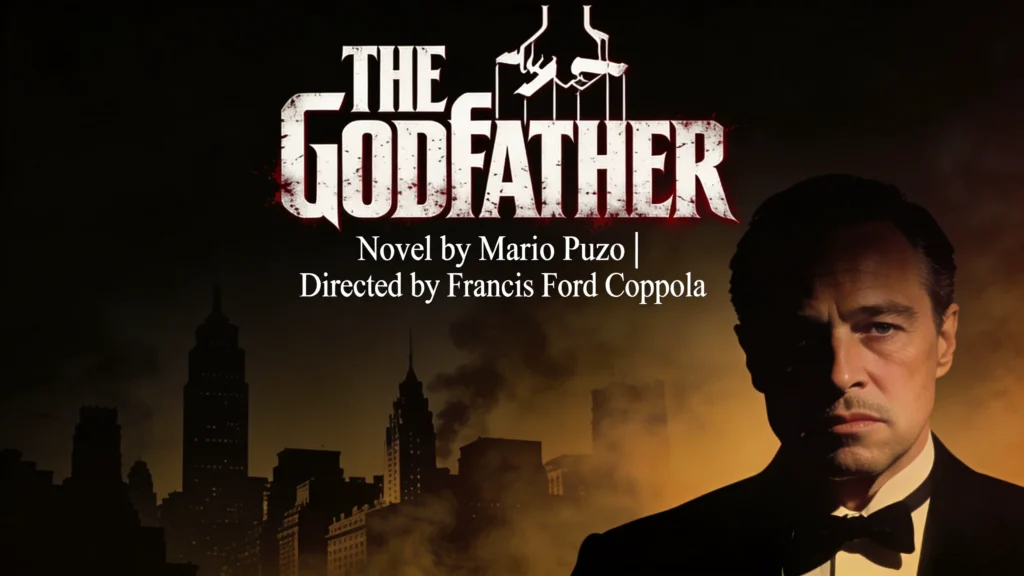
In 1969, a seismic tremor shook the world of literature, and its name was The Godfather. Mario Puzo’s masterpiece, which rattled the very foundations of fiction, received such acclaim that it remained a bestseller for 67 consecutive weeks, selling nine million copies within two years. Paramount Pictures—one of Hollywood’s most triumphant and esteemed production houses—had purchased the film rights even before the novel’s monumental success. Then, in 1972, a motion picture of supreme grandeur was released—a cinematic milestone that began decoding The Godfather for the silver screen, serving as a perfect mirror to the novel’s magnificence.
The Godfather is not merely a film; it is an entire school of art. From its conception to its release and beyond, it has inspired countless legendary tales.
A Sinking Studio and a Desperate Director
In the days when the film was being planned, Paramount Pictures was in dire straits. Most of their films had failed, the company was hemorrhaging losses, and their last picture—also in the gangster genre—had been a catastrophic failure. Under such circumstances, the studio could ill afford new risks.
Every major filmmaker of the era was offered The Godfather, but one by one, all refused. Then came the name of a man known for being both inexpensive and exceptionally gifted: Francis Ford Coppola, a novice whose last film had also failed. At first, Coppola too declined, but driven by his own financial misfortune, he eventually consented to direct.
The Sorcery of the Screenplay: Puzo’s Paradox
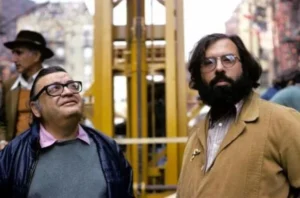
Coppola, alongside Mario Puzo, wove the screenplay and reimagined the story of The Godfather in his own distinct style. Remarkably, Mario Puzo was purely a novelist who had never written a screenplay in his life—yet he went on to win an Academy Award for Best Adapted Screenplay for this very film.
Puzo once shared a hilarious anecdote that after the film’s triumph and his Oscar win, he decided to formally learn the craft of screenwriting. But the very first textbook he found on the subject, on its opening page, advised:
“To learn to write a great screenplay, study The Godfather.”
Upon reading that, Puzo abandoned his plan to ever learn screenwriting.
Decoding The Godfather: When Rejected Actors Rewrote Cinematic History
So much has been said, written, read, and heard about this film that scarcely a facet remains unknown to the learned and the discerning. The central role of the Godfather was brought to life by Marlon Brando, one of the world’s greatest actors. Beside him, a young Al Pacino was chosen to play the youngest son and the film’s second lead, Michael Corleone.
Neither Brando nor Pacino was ever the studio’s first choice. In truth, after nearly the entire industry had rejected them, these roles finally found their way to them. Al Pacino was not then the iconic figure he is today; he was a fresh, untested face, and Paramount hesitated to trust him. But ultimately, through Coppola’s fierce insistence, the role went to Pacino.
Today, The Godfather is regarded as the gold standard of acting, and the credit belongs to the vibrant performances of Marlon Brando and Al Pacino. Both principal actors displayed such lifelike, near-real artistry that one forgets they are Brando and Pacino; in every scene, we see only Vito Corleone and Michael Corleone.
A Gangster Saga or a Haunting Family Drama?
Though The Godfather belongs to the gangster genre, we embrace it as a family drama. Its story is that of the most powerful Mafia family in New York, whose head is honored with the title “Godfather.” A refusal to engage in a drug deal irrevocably alters the life of the Godfather and his family in a single moment. When decoding The Godfather, this is the pivotal turning point: the Godfather, whose name once made the world tremble, is ambushed in broad daylight.
Misfortunes then besiege the family from every direction. How the youngest son—reluctantly, yet resolutely—takes over his aging and ailing father’s empire, how he restores the family’s honor, avenges the attack on his father and the murder of his brother, and raises the family back to its former glory—this is the epic tale that makes
Cinematic Innovation: Decoding The Godfather Effect
The Godfather is a film that has inspired filmmakers across the globe. The architecture of its narrative has shaped some of the world’s greatest films. It taught the cinematic world a new way to portray violence—violence immense and brutal, yet rendered with unprecedented artistry. It introduced new dimensions to filmmaking, the echoes of which still reverberate through cinema today.
Despite all this, from inception to completion, irreconcilable differences plagued director Coppola and the producers. Exasperated by Coppola’s many demands and his stubborn ways, Paramount resolved to remove him from the film—a move that would have completely altered how we go about decoding The Godfather today. But then Marlon Brando’s commanding demeanor came to the rescue: he flatly declared that if Coppola were dismissed, he too would walk away.
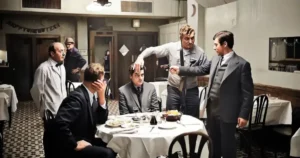
Every single scene could occupy a lecture hall of its own. The film’s opening—the procession of supplicants seeking the Godfather’s audience, contrasted against the backdrop of his daughter’s wedding celebration—establishes the film’s very foundation: no matter how ruthless, how violent, how much a gangster the Godfather may be, his family is forever supreme.
The way Coppola portrayed violence is worthy of endless praise. When Michael Corleone coldly guns down two enemies in a restaurant, at the very instant he fires, a speeding train passes by, its roar swallowing the gunshots. That scene was so spine-chilling that countless films afterward imitated the use of train sounds to mask violence.
A Lasting Legacy: The Filmofun Tribute
Marlon Brando immortalized the Don forever. There is no actor today who believes in method acting yet remains unenchanted by Brando’s performance, just as there is hardly a filmmaker untouched by Francis Ford Coppola. When decoding The Godfather and its massive legacy, you realize its DNA is everywhere; from Martin Scorsese to Ram Gopal Varma, from Rahul Rawail to Vishal Bhardwaj—there is scarcely a director who has not employed the “Godfather effect” in their work.
Like the novel, the film garnered unparalleled success and admiration. At the box office, it stood as the most successful film of the year. This masterpiece went on to win three Academy Awards (including Best Picture, Best Actor for Marlon Brando, and Best Adapted Screenplay), as well as five Golden Globes (including Best Director and Best Motion Picture).
To this masterpiece of cinema, the classic The Godfather, and all those who created it—The Filmofun offers its deepest tribute and highest reverence.