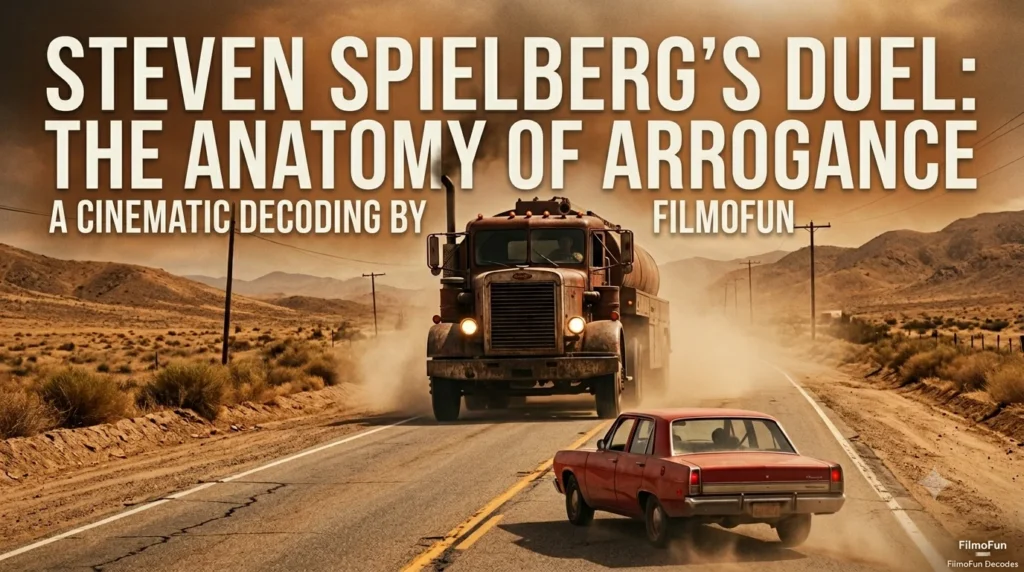

Steven Spielberg Duel Review: The Tragic Poetics of Defeat
Introduction: The Anatomy of Arrogance
Pride and arrogance remain among the most critical afflictions of human society. As we dive into this Steven Spielberg Duel Review, we see how the illusion of caste, wealth, power, or even superior knowledge divides two identical human beings into distinct, opposing classes. Suddenly, it is no longer just two individuals standing face-to-face; instead, it becomes a clash between the Brahmin and the Shudra, the elite and the impoverished, the literate and the uneducated.
What did historical tyrants like Shaddad, Nimrod, Genghis Khan, and Pharaoh all have in common? It was their absolute, consuming hubris—an arrogance so profound that they presumed themselves to be gods. For those who consider themselves divine, ordinary citizens are reduced to mere insects. They claim ownership over the lives, property, and honor of humanity. Blinded by the intoxication of absolute power, these self-proclaimed deities inflicted unspeakable cruelties upon mankind. One erected minarets out of human skulls, while another found twisted pleasure in watching living souls burn in agony. One grew mad with power building the fabled Garden of Iram at the cost of thousands of lives, while another did not hesitate to plunge spears into the chests of newborns just to protect his throne.
To sustain their divinity, these tyrants demanded absolute submission, for the ultimate satisfaction of a false god lies hidden in the prostration of the servant. Out of pure terror, thousands bowed their heads and fell to their knees. However, the ultimate twist in these historical sagas only occurs when someone finally refuses to bow—when someone stands tall and looks these pharaohs dead in the eye.
The Inciting Incident: A Highway Confrontation
This is precisely where our story begins. David Mann (played by Dennis Weaver) sets off in his modest family sedan for a business deal in another city in California. Shortly after leaving the city limits and hitting the open highway in Spielberg’s 1971 masterpiece, he encounters an antiquated, monstrous fuel tanker truck.
This reddish, colossal titan of a vehicle refuses to let David pass. After some effort, David finally manages to overtake it. The moment he does, the truck’s thunderous horn lets out a deafening roar—as if the giant could not tolerate the sheer audacity of a tiny, mouse-like car overtaking it. This very moment serves as the genesis of a relentless duel, a face-to-face warfare, and a deadly trap that David is forced to join against his will.
Spielberg’s Visual Mastery and Sound Design
Richard Matheson brilliantly adapted his own short story into a screenplay, which Steven Spielberg then brought to life using the language of the camera. The ultimate villain of Duel is the truck itself. The core objective of the film was to make the audience feel the protagonist’s paralyzing terror and to inject pure adrenaline into the viewer’s veins.
To cultivate this atmosphere of dread and to make a mechanical vehicle look terrifying, Spielberg’s calculated camera movements, sharp close-ups, sweeping long shots, and crisp editing are in a league of their own. Another extraordinary feature of the film is its meticulous sound design—whether it is the eerie atmospheric background score, the piercing roar of the truck’s horn, or the sudden, erratic movements of vehicles on the asphalt. Spielberg’s truck gets angry on his command, roars with malice, laughs at David’s utter helplessness, and actively dares him to fight. Ultimately, any deep Steven Spielberg Duel Review must recognize how he achieves this cinematic miracle using nothing but an ugly, faceless machine.
FilmoFun Decodes through an English Haiku
Red titan of rust,
Pharaoh of the open road,
The small sedan bleeds
The Faceless Tyrant in Steven Spielberg’s Duel
Throughout the entire film, the truck driver’s face is never revealed to the audience. In a couple of fleeting moments, we only catch a glimpse of his rugged boots or his arm extending from the wrist to the elbow. Leaving the driver anonymous was a masterful narrative choice. As highlighted in our Steven Spielberg Duel Review, the truck functions purely as a symbol of unyielding pride and arrogance—a force that simply cannot tolerate seeing a weaker entity move ahead of it.

This truck is the Genghis Khan and the Pharaoh of the highway. It demands absolute followers, and anyone who dares to cross its ego must pay a devastating price, perhaps even with their life. In a brilliant display of psychological warfare, the truck even pauses to help a stranded school bus by the roadside, behaving like an arrogant, benevolent conqueror just to bait David back onto the tarmac.
Conclusion: The Point of No Return
Initially, David is completely paralyzed by the terror of the monstrous machine. During the high-tension diner scene, he desperately scans the feet of the patrons, hoping to identify the driver by his boots. However, a relentless series of terrifying events eventually pushes him to the brink, embodying the classic maxim: “A cornered animal fights rarest.” He ultimately internalizes the timeless truth:
Neither your name nor your tyranny shall endure, O Oppressor,
When neither Pharaoh nor the armies of Genghis survived the test of time.
What happens when the mouse finally turns to face the monster? For that, you must experience this cinematic masterpiece yourself.