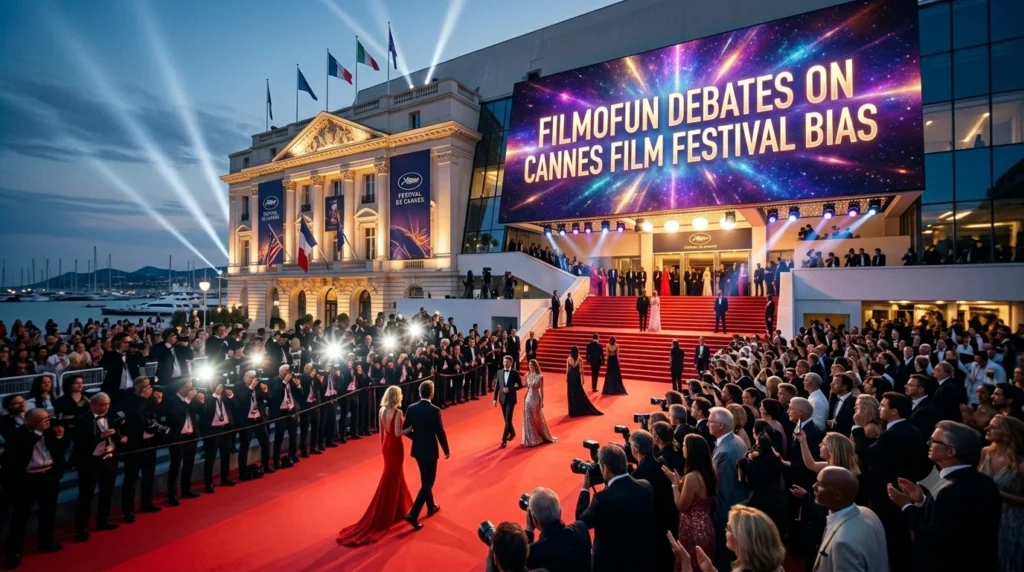

Cannes Film Festival Western Bias: The Postcolonial Politics of Cinema
The Cannes Film Festival bias is an open secret, hidden beneath the glamour of its red carpet. Typically, the event is revered as the gold standard of “art for art’s sake,” “aesthetics par excellence,” and “cinematic perfection,” but a postcolonial analysis suggests that Cannes is fundamentally complicit in the world’s power structure. The festival not only screens films but decides whose story is worthy, whose art can be labeled as “legitimate,” and whose reality will define the Global South’s image on the world stage.
Red carpet glows bright,
Western eyes judge Eastern souls,
Truth is cast in chains.
Edward Said’s Orientalism and the Cannes Film Festival Bias
In order to comprehend the deep-seated Cannes Film Festival bias, it is necessary to analyze the issue through the eyes of the renowned Edward Said’s Orientalist theory. As Said claimed, the representation of the East by the Western world is achieved by using very particular and controlled methods which do not rely on politics or militarism but knowledge.
According to this scheme, post-colonial nations can only exist in a form of rigid stereotypes such as:
- Chronic instability and backwardness
- Hyper-emotionalism and irrationality
- Deep-rooted misogyny and cultural crisis
This is done by constantly reinforcing these very same images, thus allowing Western civilization to continually assert its own superior culture in terms of what they believe is right about the Global South.
Cannes Film Festival Bias: Frantz Fanon and the Colonized Mind of the Elite
The ideological structure of empire has not ceased to exist upon the disappearance of empires. Today, the process of colonization occurs in the guise of the festivals circuit, international financial institutions, and transnational media structures. It is within these structures that festival movies are produced by the dominant culture.
As pointed out by Frantz Fanon, colonizing is not only about capturing land but about colonizing the mind. Gradually, members of the elite from post-colonized states start thinking about their indigenous culture from the perspective of an outsider. Their culture, languages, and ways of living develop an inferiority complex. Therefore, in order to receive funding and approval, these indigenous film makers have to create stories for their movies based solely on western imagination and expectation.
Cannes Film Festival Bias:
The Dangerous Reduction of South Asian Realities
If the members of a community feel that their distinctive stories and emotions will never be considered “universal” unless they are authenticated in Europe, there will always be mental subjugation in such communities. It is here that the structural Cannes Film Festival bias comes under great scrutiny because the festival routinely celebrates a rigid formula:
- The Men: Depicted exclusively as ruthless tyrants and oppressors.
- The Women: Portrayed solely as helpless, silent victims.
- The Tradition: Framed entirely as primitive and stagnant.
- The Urban Elite: Presented as the ultimate, enlightened saviors.
By enforcing this formula, complex, multifaceted societies are reduced to a flat, negative caricature for Western consumption.

Familiar Imperial Frames vs. True Social Realities
With regards to the global cinematic gaze, issues that easily fit into the imperialist and liberal framework will immediately gain prominence. Themes such as gender discrimination, fundamentalism, and sex politics easily capture attention as they fit into a common framework of understanding among westerners, thereby reinforcing the Cannes Film Festival bias.
On the contrary, the actual socio-economic reality of the Global South is deliberately excluded from the picture. Some examples include:
- The complex, nuanced lives of rural farmers
- The systemic exploitation of the working class
- Illegal mining and corporate plunder of local resources
- The long-term devastating impacts of modern economic slavery
This process of art selection operates quietly under the guise of being an “aesthetic” decision, but its political and ideological nature cannot be ignored. The local aesthetics, which comprise folklore, mysticism, regional languages, and resistance, are considered “parochial” and “non-universal,” whereas the tastes of the westernized urban classes are regarded as “civilized” and universal.
The Corporate Spectacle of Modern Cannes
Currently, however, the festival fails to elude scrutiny over its commercial transformation. In addition to the high-end film discourse that surrounds the event, the Cannes Festival has transformed from a smaller affair into an enormous corporate carnival, characterized by luxury branding, influencer marketing, and social elitism.
In such a highly commercialized context, the artistry of cinema frequently takes second place to its strategic staging. The symbolic red carpet becomes much more of a media spectacle than a cultural landmark. Indeed, a system has emerged whereby the value of a movie is directly related to geopolitics and Western marketability.
Conclusion: Who Decides What is Universal?
The colonial critique of the Cannes Film Festival western bias compels us to question: Who was behind the creation of the concept of global cinema? Who has the authority to distinguish which films qualify as global masterpieces while others are regional and insignificant?
The incessant praise of stories that justify a particular colonial ideology reveals that cinema is indeed a political endeavor. In order to decolonize our screens, we must understand that the conflict between aesthetics, representations, and knowledge is nothing less than a cultural warfare waged against us in silence.